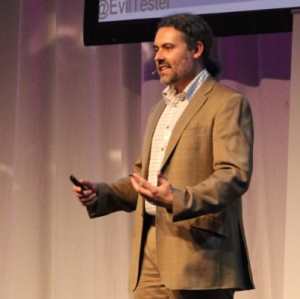
On 16 March 2011 I presented “Learning, Developing, Evolving: The Path of the Technical Tester” at the BCS SIGIST conference in London.
The talk explored how testers can develop technical skills by modelling systems, observing and manipulating the technology, and building testing approaches from first principles. A worked web-application example expands from a form into browsers, servers, architecture, and users.
The original BCS programme lists the talk at the Royal College of Obstetricians and Gynaecologists. The agenda is on page 3 and the abstract is on pages 5-6.
Materials on GitHub
- All SIGIST 2011 materials
- Slides - Markdown
- Slides - PDF
- Speaker notes from the presentation
- Prepared talk script
- Prepared outline
- Preparation notes, abstract, and research
- Draft technical-testing paper
All 23 slides are preserved. The PDF was generated from the original PowerPoint. The notes, script, outline, and draft paper are preparation materials, rather than transcripts of the delivered talk. The draft paper retains its unfinished sections and placeholders.
Technical Testing: AI-Generated Summary
AI generated this condensed summary of Alan Richardson’s original technical testing paper, retaining its punchy style without speaking as the author. The summary paraphrases the unfinished 2011 draft in E-Prime. It leaves the draft’s missing sections unexpanded.
Testers Need to Change With the Work
Software development changes. Testers need to keep learning if they want to keep contributing.
On some projects, testers can still spend months analysing requirements, writing scripts, and maintaining documents. But when teams work closely together, deliver frequently, and expect requirements to change, that approach struggles. The separate test phase shrinks. The work spreads across the team. Developers and business analysts can write automated tests. Everyone can help check whether the software meets a requirement.
Testers still have plenty to do. We can explore, question, model, and investigate risks that the existing tests miss. That requires us to learn more about the systems we test.
Becoming more technical adds to our testing. We keep the useful skills we already have and extend the range of things we can understand and investigate.
A Definition Can Become a Cage
Definitions deserve suspicion. Give someone a tidy definition of technical testing and they may start treating its edges as the limits of their work.
The approach starts with technical risk and system modelling. Technical testers learn how the system works, build models of it, and use those models to decide what to investigate. Sometimes an existing technique helps. Sometimes we have to construct an approach from first principles.
The label “technical testing” offers convenience. Systems thinking and modelling describe the approach more closely. The system includes the application, browser, data, communication, configuration, and the other parts that make the thing work.
Our ability to investigate that system depends on our knowledge and skill. Every gap in our understanding limits what we can see and what we can try. That gives us something concrete to work on: learn the terrain.
Build Maps. Explore the Terrain.
Think of the system we interact with as terrain. Our maps represent what we understand about it.
We carry many maps. A requirements model describes expected behaviour. A flow model describes a sequence. An architecture model describes components and communication. A data model gives us another way to understand what happens. Each helps us ask different questions about the same system.
We identify risks by examining these models and observing the terrain. We describe coverage through the models we use. When we interact with the actual system, we may discover something our map does not represent. Then we have a reason to change the map.
Technical knowledge lets us build more detailed maps and investigate more of the terrain. It also exposes gaps. If we discover that a form sends data to a server, but do not understand how, we have found something useful to learn.
The model earns its keep by helping us explore. A diagram filed away after producing a pile of test cases has lost much of its value.
Observe and Manipulate
Two simple actions help organise a technical tester’s thinking: observe and manipulate.
What can we see? What can we change? What would we need to learn to see more or change something deeper in the system?
These questions give tools a purpose. If our model suggests that we need to inspect communication, we look for a way to observe messages. If we want to vary those messages, we need a way to manipulate them. The model helps us identify the capability we need, then find a tool that provides it.
Knowing a collection of tools has value. Understanding which parts of the system they let us observe and manipulate makes that collection useful to our testing.
A Search Form Has More to Tell You
Consider a search form. Type something into a field, press Search, and inspect the result. That gives us a useful functional model. We can explore more terrain.
View the source. Now we have HTML, a form submission, JavaScript, an image, and styles. We can investigate the browser’s rendering, the data sent to the server, and the mechanism that remembers a previous search.
The paper’s example uses a standard HTML form that submits with POST. JavaScript in the browser maintains its previous-search state. Those observations change the testing approach.
We could send input variations directly to the server. They need not all travel through the browser interface. The browser-side state behaviour gives us a reason to investigate multiple browsers. Different parts of the system lead to different questions and different ways of exercising them.
From here we can ask how to submit without pressing the button, inspect the current DOM, or vary the submitted data. Each question comes from something we have learned about the system. Each answer may change our model again.
A tester who does not know HTML can start here too. Find out how to view the source. Learn what the elements mean. Apply that knowledge to the application in front of you. Technical knowledge develops through this work.
A Boundary Depends on Your Model
Suppose an input field has maxlength="20". A familiar recipe tempts us: try 19, 20, and 21 characters, record the results, and move on.
But where does that limit apply? The browser enforces it. What does the server accept? What happens when a request reaches the server through a different route? Does the twenty-character limit come from a requirement, an interface choice, or a constraint somewhere else in the system?
Perhaps the database field holds twenty-five characters. What happens when twenty-six reach it? Perhaps the database stores the value without that limit, but another screen displays it under a different constraint. Follow the data. Find the other boundaries.
Boundary-value analysis can offer a useful hint. Trouble starts when completing the familiar calculation convinces us that we have finished thinking.
An ordered set, a browser field, a server request, and a database representation can each suggest different boundaries. Understanding those models gives us more to investigate than treating the first number we see as the whole problem.
Keep the Model Behind the Technique
State-transition graphs, graph-based testing, and domain analysis offer value through the models they make explicit.
Building a graph forces us to think about states, transitions, and relationships. Exploring it can reveal questions we had not considered. If we only wanted to mechanically derive a large set of cases, we could automate that derivation.
Keeping the cases and throwing away the model creates a danger. We retain the output of the thinking while losing a useful means of thinking further.
The same danger applies when a useful heuristic becomes a rigid technique. A hint based on past defects can help us find another defect. It can also become a stopping point if we forget to examine the system that made the hint relevant.
Learn why an approach works. Learn what it assumes. Then decide how it applies to this terrain.
Say What You Actually Tested
Testing terminology can make a vague explanation sound complete.
Saying that we performed “negative testing” leaves other testers guessing. Describe which values we entered, which error-handling paths we exercised, and what we observed, and we can discuss the testing.
“Black box” and “white box” can encourage us to divide knowledge into two neat categories. Our knowledge of a system has degrees, gaps, and overlapping models. Areas we understand poorly deserve attention because defects may remain hidden there.
“Functional” and “non-functional” can produce similar ambiguity. The words alone tell us little about the behaviour investigated or the model used to choose it.
Describe the models, risks, actions, and observations. That gives another tester something they can understand, question, and build on. A category name should never do the work of an explanation.
Keep Learning Beyond the Testing Books
Testing already borrows from other disciplines. Graph theory can deepen our use of flow models. Set theory, statistics, and data analysis can improve how we think about data and categories.
We can keep learning from those fields. A fixed collection of simplified techniques should not become the limit of our testing knowledge.
Treat this approach as another model, with its own biases and gaps. Examine it, try it against the systems you test, and discover where it helps or fails.
Learn more of the terrain. Build better maps. Use them to find the next question worth investigating.