Software Testing and Development Blog Posts
Subscribe to the full blog feed using RSS
Subscribe to the full blog feed using RSS

TLDR; The Art of War Chapter 13, on spies, is directly applicable for interpretation in terms of Software Testing.
TLDR; Getting started with programming is the hardest part. Installing the IDE, adding dependencies, writing your first test. Pick whichever language you have someone to help you with, or you have a tutorial to work through. Switching languages when you know one is not too hard so do not worry about being stuck with a language, focus on getting started.

These comics have been collated here from individual blog posts over the years.
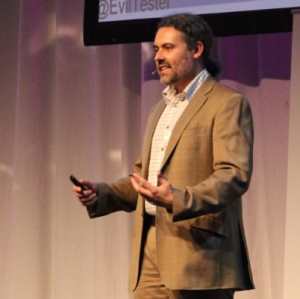
A remote talk held on 14th December 2019 for The Bishkek Dev Fest.
I tested an application for about a day, making notes, and then generalised these into lessons learned and categorise of Test Sessions to help build a better model of how I approach testing.
This talk is available as an expanded (31 video) course on Patreon
Have you ever wondered how other people test applications? Not in theory, but in practice? What thought processes are used? How did they model the application? What tools were used? How did they track the testing? That’s what this talk is all about. This talk will be based on a short Case Study of testing an open source web application. Why open source? Because then there is no commercial confidentiality about the process, tools or thought processes. Alan will explain his thought processes, coverage, approaches, tools used, risks identified and results found. And generalise from this into reusable models and principles that can be applied to your testing. This covers the What?, and the Why? of practical exploratory web testing.

TLDR; Every approach to automating has risks, issues and benefits. Often we don’t think these through. When we do we will see that automating has a different set of answers than automating strategically. This helps reinforce the difference, without having to stick to definitions.
In my conference talks and on my blog I make a distinction between Automating Tactically and Strategically. In this blog post I will conduct an exercise to look at the benefits, risks and issues associated with a particular example of automating tactically.
TLDR; I automated the unchecking of all Twitter Interests using simple JavaScript at the console. I explain the code I wrote, and how I wrote it to act as a case study in Tactical Automation.
Twitter Interests have been automatically collated. You can manually review and amend these (there might be hundreds). I decided to uncheck them all. And did so automatically.

TLDR; Be clear in what you want. Do work and research on your own first. Explain your current position to provide context for what you have done. Do look for help to take the responsible next action.
TLDR; A collection of tips for working with HTTP Proxies. Use a proxy against localhost or from mobile by using your machine name or private ip address from ifconfig (or ipconfig). Chain proxies to use features from all tools at the same time and make request manipulation more reliable. Charles proxy can validate HTML as you test.

TLDR; use abstractions for precision and create new abstraction layers which model state and data flow rather than adding it to lower level classes.
This post was created as a response to a question I was asked over email regarding approaches for modelling data re-use in abstractions.
What does it mean for Buggy Software to be normal? Does that mean we get complacent? What can we learn by coding in JavaScript and HTML? Do we reach for professional tools too quickly? Or even not at all? This collection of micro posts answers these questions, and provides some exercises and tool links.