Software Testing and Development Blog Posts
Subscribe to the full blog feed using RSS
Subscribe to the full blog feed using RSS
TLDR; Study examples of automating a game in browser using JavaScript from the dev tools console, and an example of automating outside the browser using a standalone execution tool.


SauceCon 2020 was moved online as a free conference.
One of the biggest concepts that has made a difference to my programming and automating is the concept of “Tactical Vs Strategic”. Tactical being for a specific purpose, possibly a bit rough around the edges, not necessarily completely robust for everyone, etc.. And Strategic being critical to long term aims, maintained and maintainable, etc. In this talk I will provide examples of both strategic and tactical automating for activities as diverse as supporting testing, marketing and general life. We will also consider how and when to move from automating tactically to strategically. And how the concept has helped me change my programming style and how I write code.
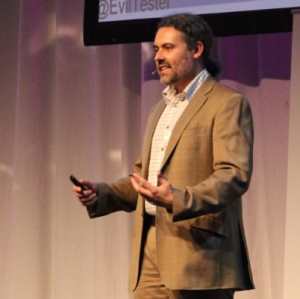
On 28th April 2020, I presented in a Webinar with Joe Colantonio.
The webinar was sponsored by Virtuoso.qa
I provided a short presentation on how testing will change in short and long term. And then there was a Q&A session between Adil Mohammed, Joe Colantonio and myself.
You can sign up to watch the live webinar recording with full Q&A using this link.
You can also read a summary of the webinar on the Virtuoso.qa blog
With so many conferences moving online, it seems worthwhile sharing a few tips about online presenting.
And that’s the topic of this podcast.

TLDR; A collection of tips for presenting online presented on The Evil Tester Show Podcast Episode: get a decent microphone.
500+ videos of experience, crammed into one tiny blog post.
TLDR; A lot of good resources for learning JavaScript exist. And you do not need to install an IDE, you can learn JavaScript in the console.

TLDR; Coverage requires some sort of model. We can organise code to support review against a mental model, and some models are executable. Other models we compare against the output of execution.
I was asked a series of questions: How can we document what an automated test does and covers without adding a lot of overhead? How do we know what is not covered by automation?
I receive a lot of emails asking which way should people focus their career - Testing? Programming? Automating?
And that’s what I cover in this podcast.
TLDR; Observation in real time. Interrogation after the act. Bringing Interrogation closer to Observation can help detect issues during a process. The depth of Observation and Interrogation changes depending on our knowledge of the system and technology. And we may not be done, if our observation was limited.
When I test I make a distinction between Observation and Interrogation and I’m going to explain what that means, and show you hands on example of how that distinction helps me improve my testing and the scope of of my testing.
TLDR; Testing uses models to target the system, and our information is constrained by the models we use and build. We can introduce variation to increase the possibility of finding information related to bugs. We have to take care not to develop false confidence.